
The Philippines remains on track toward sustainable mobility as the public and private sectors gear up to collaborate further and push for massive local adoption of electric vehicles (EVs). Through the Electric Vehicle Development Act (EVIDA) enacted in 2022, the EV sector continues to grow, attracting more investments from both local and international companies.
Earlier this month, the Board of Investments (BoI) announced that a Chinese delegation is exploring the possibility of establishing local facilities for EV and renewable energy equipment manufacturing. While details have yet to be disclosed, the agency confirmed that the deal is likely to move forward.
Meanwhile, the Department of Energy (DOE) has received expressions of interest from private investors aiming to roll out 4,000 EV charging stations nationwide within two to three years.
In June, Mitsubishi Motors Philippines Corp. announced plans to invest an additional ₱7 billion over the next five years, aligning with the government’s push for EVs and renewable energy. Around the same time, the Department of Trade and Industry introduced the Electric Vehicle Incentive Strategy (EVIS), which, once approved, could generate up to ₱11.4 trillion in economic output and create nearly 700,000 local jobs in EV assembly, battery production, and maintenance services.
The Asian Development Bank (ADB) has also pledged $100 million (around ₱5.84 billion) to the local EV sector through a partnership with Ayala Corporation’s ACMobility, one of the country’s largest EV distributors. The funding will support the procurement of charging stations and additional EV units for commercial use.
In September 2024, Australia’s StB GIGA Factory opened the country’s first EV battery facility in New Clark City. The plant aims to produce 2 gigawatt-hours of batteries annually by 2030, enough to power 18,000 EVs, with a portion intended for export. This milestone is expected to attract more foreign investments into the EV and renewable energy sectors.
These developments align with the Comprehensive Roadmap for the Electric Vehicle Industry (CREVI), which targets the deployment of 7,300 EV charging stations by 2028 and over 20,400 by 2040 to serve an estimated 2.5 million EVs nationwide.
“After lobbying for the legislations and national policies that initiate and propel the growth of the local EV sector, we recognize that this is a crucial time,” said EVAP President Edmund Araga. “EVs require sufficient and reliable charging infrastructure, as well as advancements in battery technologies. We continue to support partnerships with the private sector and investors to achieve this.”
Araga emphasized that the EV sector is fueling nation-building through job creation, economic growth, and environmental sustainability while addressing the rising costs of petrol.
EVAP and its partners remain committed to supporting the government’s efforts to deliver safe, efficient, and reliable mobility to Filipinos.
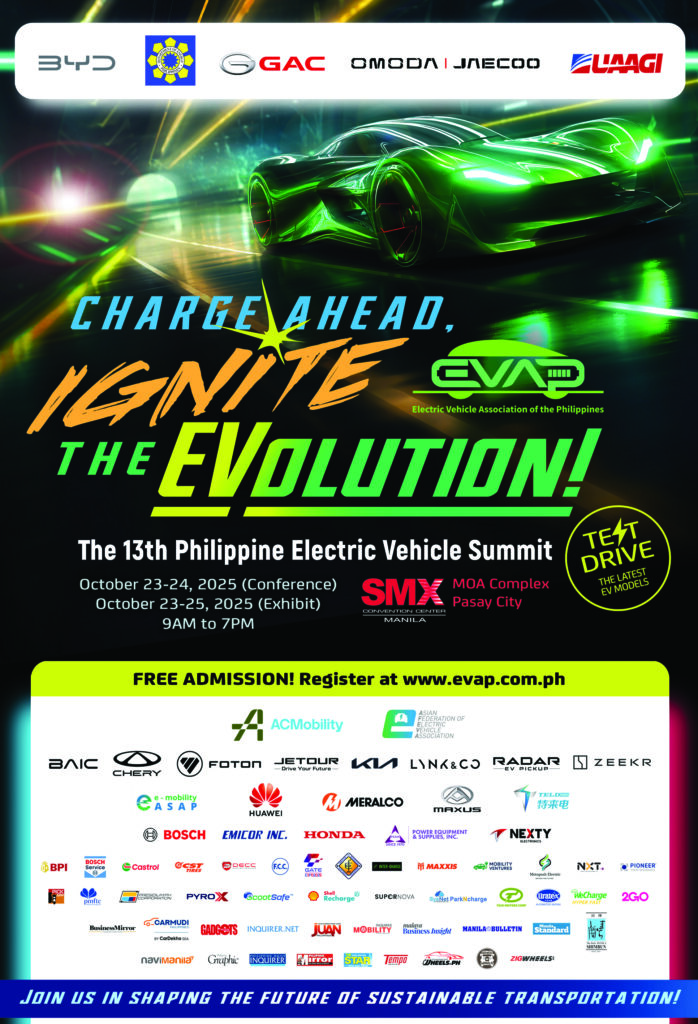
These efforts take center stage at the 13th Philippine Electric Vehicle Summit (PEVS), happening from October 23 to 25, 2025, at the SMX Conv
ention Center Manila. With the theme “Charge Ahead, Ignite the EVolution,” PEVS 2025 will showcase the latest innovations, technologies, and models from leading EV brands.
PEVS 2025 is presented by EVAP in partnership with BYD Cars Philippines, Omoda & Jaecoo Motor Philippines Inc., United Asia Automotive Group Inc. (UAAGI), GAC Dangdang, and the Department of Energy.
Learn more and register for free at pevsummit.com.