
When we first learn about natural disasters and calamities in school, our parents and teachers teach us how tools at our disposal help us stay safe and updated. News channels and radio stations keep us informed, rain or shine—not just about class suspensions, but also the conditions of areas we resided in and communities that needed help.
Today, we have new tools available to help us prepare for—and stay informed about—challenging weather conditions. Aside from websites, social media, and other online platforms, there are apps now, too, that help provide more accessible updates and information.
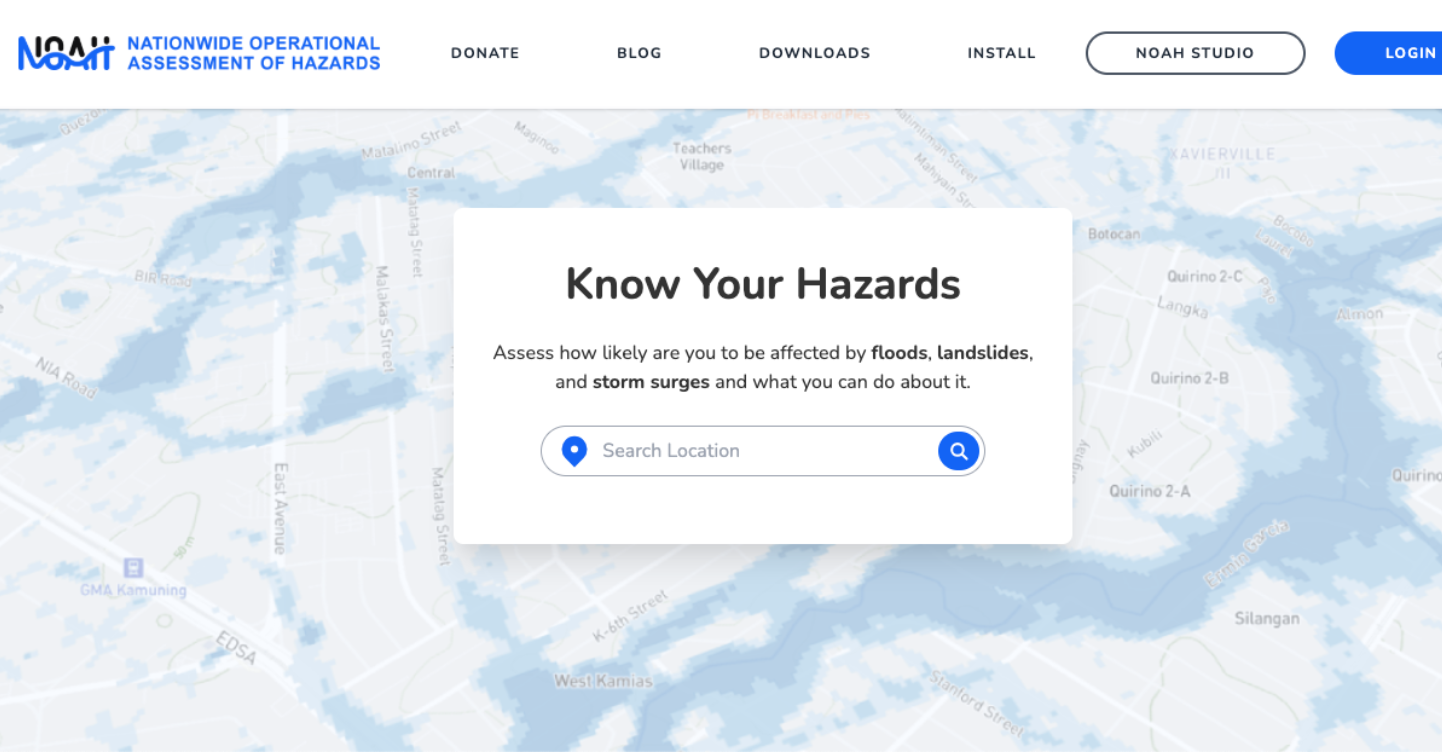
Photo: UP NOAH
Recent typhoons Crising, Dante, and Emong have devastated families and homes across the nation. Moreover, Filipinos’ reactions and responses to the high-risk floods and large-scale structural damage during these typhoons quickly become a lesson for everyone in disaster and risk communication.
In times of crisis and calamities, people heavily rely on clear, precise, and accurately disseminated information. The Nationwide Operational Assessment of Hazards (NOAH) by the University of the Philippines (UP) is a timely and useful platform for risk assessment, disaster management, and contingency planning for affected communities. It doubles as a go-to source for typhoon developments and updates, too. Here’s everything you should know about the NOAH app, and why you should always have it at hand—in case you haven’t downloaded it yet.
An Accessible Virtual Initiative

Photo: UP Resilience Institute/Facebook
UP, led by its Resilience Institute (UPRI), established NOAH in 2012 as a multi-purpose management program for researching natural hazards and advocating for climate action and disaster risk reduction nationwide. The Department of Science and Technology (DOST) funded UP NOAH from 2012 to 2017 to help Filipinos respond promptly to extreme and destructive weather conditions. Flood information networks, landslide sensors, and storm surge mapping were just a few of UP NOAH’s fundamental projects that the DOST supported before the program went full-force, adapting to more advanced and accessible platforms.
In 2021, UP NOAH launched its website—a straightforward, location-based assessment for floods, landslides, and storm surges across all regions. All you had to do was enter your current location, and the website would list hazard levels and critical nearby facilities for your convenience. The UPRI introduced the same features in beta tests of the NOAH app in 2023, and it successfully launched on the App Store on March 28, 2025.
The NOAH app is now a leading platform for hands-on risk reduction initiatives nationwide. Instead of relying solely on widespread communication channels, the app covers locations specific to your communities. These include far-flung areas that the news and social media can’t usually reach.
Hassle-free App Navigation
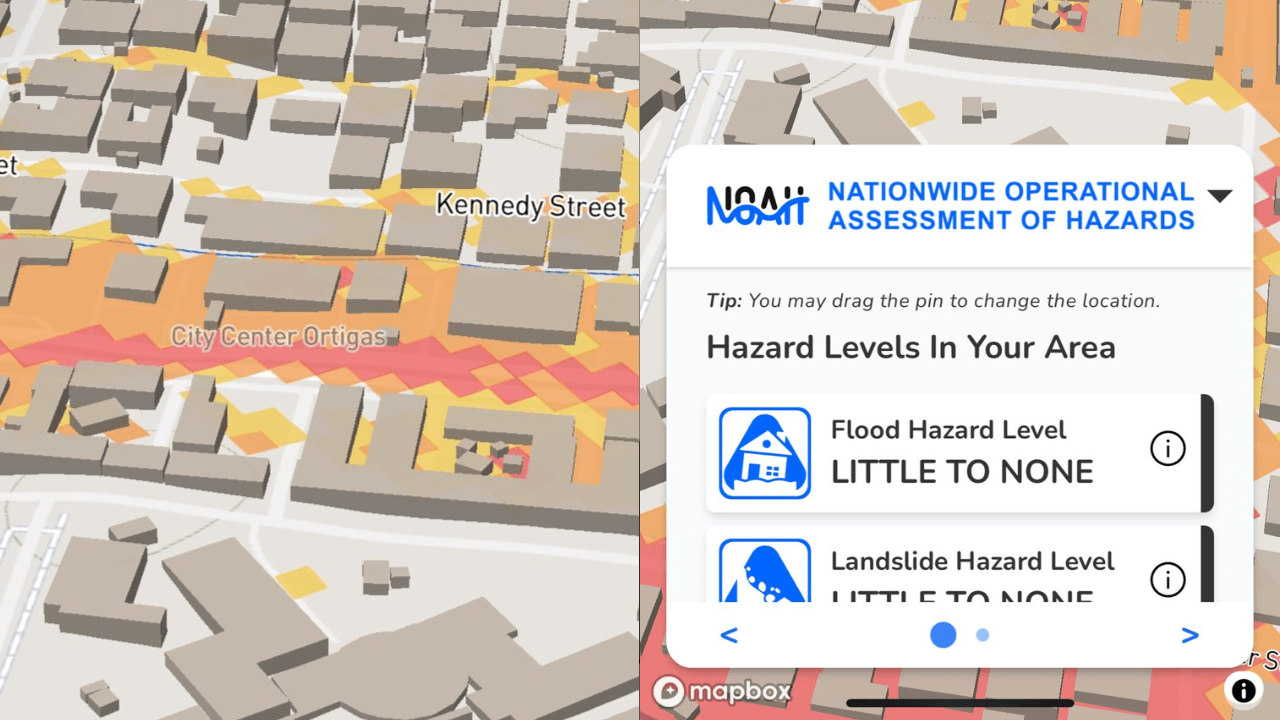
Photo: UP NOAH
User-friendly features are one of the first practical assets you’ll notice upon opening the NOAH app. No walls of unnecessary text blocking the information you seek, or complex menus that take you everywhere but the page you originally clicked on. You don’t even need an account!
Once the NOAH app knows your location, it’ll map out surrounding areas and their hazard levels for floods, landslides, and storm surges. The app also utilizes colors to identify hazard-prone nearby streets, with yellow indicating low hazard levels, orange for medium hazard levels, and red for high hazard levels. In addition to real-time risk updates, the NOAH app provides a list of safe facilities within your area when you’re vulnerable to danger and uncontrollable hazards.
The Driving Forces of NOAH
Disaster scientist and UP professor Dr. Mahar Lagmay is the executive director of NOAH. From the app’s ideation stage to its nationwide launch, Lagmay has nurtured the project and its advocacies for climate action into a major step towards solving the country’s severe calamity problems. For him, the NOAH project as a whole also helps environmental workers approach flood control plans in a more nature-based way.
“It’s a change in mindset. It’s a change in the way we do things. We have to change the status quo. If we use science more to understand the problem, then we can find better solutions. We have a way of doing and executing things, and we’re so used to it. We must have that change in mindset to embrace the science and see how it can work for us,” Lagmay told ANC on July 22, 2025.
Whether we’ve seen the NOAH app on our timelines or used it for optimal safety, the app and Lagmay’s insights on it teach us how we shouldn’t take Filipinos’ contributions to scientific fields for granted. The disaster management practitioners, researchers, environmental specialists, and climate advocates in our midst deserve year-round support for their communal endeavors. We shouldn’t just place utmost importance on them whenever it rains.
The UP NOAH app is available for free on the App Store and Google Play. You can support UP NOAH’s and UPRI’s future projects by donating to their respective accounts.
ALSO READ: PAWS Urges Safety for Impounded Dogs and Cats Amid Typhoon Kristine
Have you already downloaded and tried the NOAH app? Share your experiences with the app in the comments below!
Do you have a story for the WhenInManila.com Team? Email us at wheninmanila@gmail.com or send us a direct message at WhenInManila.com’s Facebook Page. Interact with the team and join the WhenInManila.com community at WIM Squad, and join our Viber group to stay updated with the latest around the Philippines and beyond!