
(Warning: May contain spoilers)
Review by Cas Aseoche
It all began with Nick Joaquin’s book titled A Question of Heroes, which gave us the very timely thought in this age of rapid disinformation and malinformation: How do you define a hero, and do we truly have real ones? This analysis eventually realized Heneral Luna (2015), continued on with Goyo: Ang Batang Heneral (2018), and now (after a while in pre-production hell) released Quezon.
It takes a decade of following where this question has led Direk Jerrold Tarog (and co-writer Sir Rody Vera for Goyo and Quezon). The audience becomes faced with creative analyses of three “heroes”, and the complexity of human nature—especially when brought onto a pedestal. Very easily, we get to realize that disinformation and malinformation have been an ailment in our country for hundreds of years.
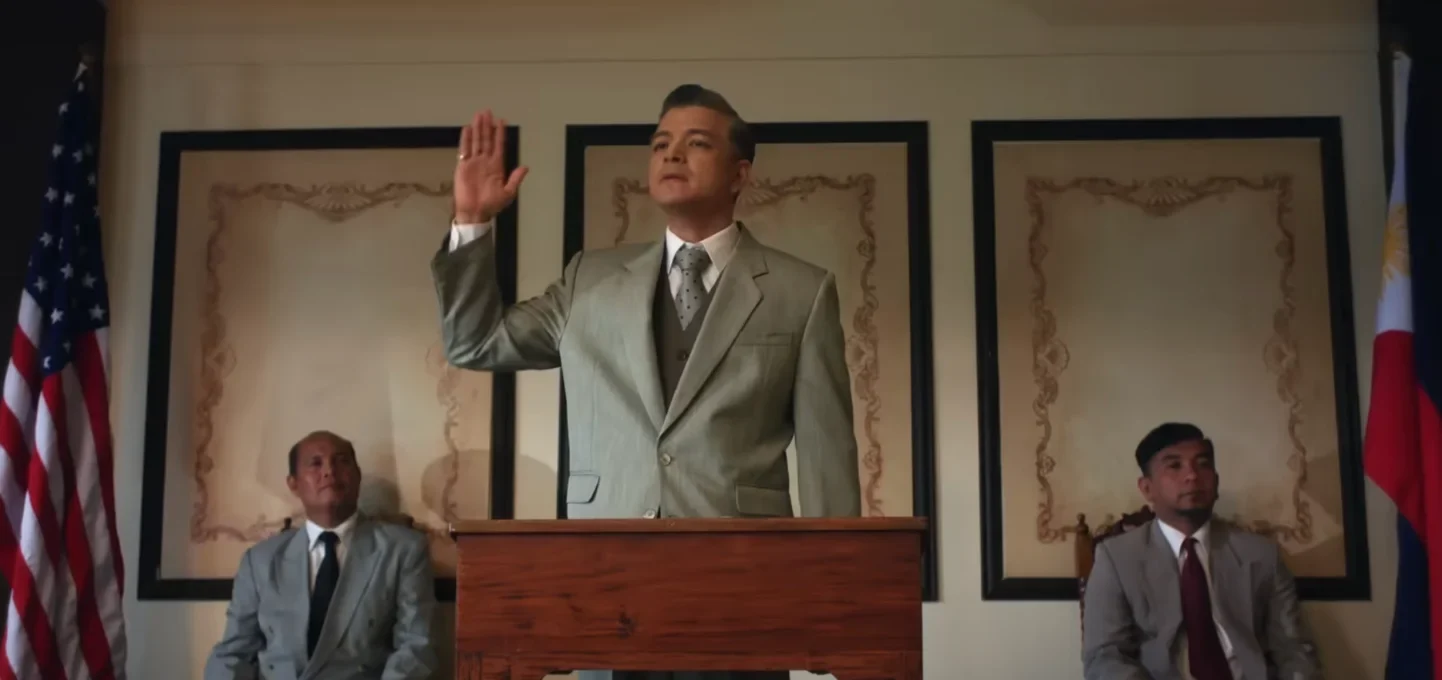
Photo: TBA Studios/YouTube
Headlined by Jericho Rosales as the older Manuel L. Quezon during his presidency (formerly portrayed in the post-credits scene of Goyo by TJ Trinidad before his retirement from acting), the film Quezon is yet another ode to the Filipino people to keep our eyes and ears wide open, and our minds sound.
The film is set with a dual timeline, as an older Joven Hernando (played by Cris Villanueva) watches an alternate version of a Vote For Quezon! propaganda film that his daughter, Nadia (played by Therese Malvar), directed. He commentates alongside Eduardo Rusca, played by Joross Gamboa. Funnily enough, the in-universe actor portraying a younger Quezon in Nadia’s film is none other than Benjamin Alves, who actually did play the younger Quezon in both Luna and Goyo.
We get to see just how Quezon reassesses the pieces of his long game, before we’re taken back to the past to see just how he built himself a new hand to deal with for the future. The back and forth between the past and present timelines is done seamlessly, the scenes of Nadia’s film quite literally pulling us into the truth behind the propaganda shot.
Quezon is extremely timely with just how much virtue and morality are discarded by those in power, in their search for power—an ailment of society from then until now, that we all need to open our eyes to before it’s too late. Rosales’ Quezon lays it out to the audience himself, even: that virtue and ethics are but theory to him, and any principles he once had can be easily changed in order to move an entire country forward.
Nadia’s alternative film, coming from an idea from her Lolo Miguel (played by Jojit Lorenzo) to shoot a more truthful version of Quezon’s story alongside the propaganda version, is not just an eye-opener but also a feast for the eyes—Sir Pong Ignacio returns once more as the series’ director of photography. It’s mentioned that one of her favorite filmmakers was Fritz Lang, and it’s immediately apparent in the visuals of a young Quezon in prison, walking and reaching towards sunlight as “he gains inspiration to help and lead the Filipino people to prosperity”. His makeup, wardrobe, and direction are reminiscent of Freder Frederson from Lang’s Metropolis, and the analogy is almost perfect as the character is called a “mediator” between the hands of the working class and the minds of the ruling class. The man Quezon, however, is far from the “heart” of Freder, who is meant to be compassionate and empathetic, and not sneaky and ambitious.

LEFT: Benjamin Alves as young Manuel L. Quezon in “Quezon”; RIGHT: Freder Frederson in “Metropolis”
President Quezon meets an unextravagant conclusion in the movie, despite all his pizzazz, career-making, and power-playing while alive. It’s almost like karma, that all he’s reduced to is a bloody coughing fit, shouting between curses towards Sergio Osmeña (played by Romnick Sarmenta). However, true karma can only come once we take the tale so carefully woven by Direk Jerrold Tarog and Sir Rody Vera to reality, and learn from the mistakes of our forebears to create a better future for us that hopefully isn’t so deeply ridden by corruption.
This review is but the tip of the iceberg, as performances by the rest of the stellar-studded cast round out the film. Karylle brings a strong but quiet woman in Aurora Quezon, who manages to stand her ground right next to a heavily flawed man; and Mon Confiado’s ever-alive Emilio Aguinaldo continues his journey watching the Philippines rise and fall over and over again (his long life alluded to in the closing text). Sir Iain Glen’s Leonard Wood also becomes the worthy opponent to Quezon’s little game of power, not so willing to back down or let himself sway to his whims.

Photo: Pong Ignacio & Trixie Vertera
Truly, the culmination of the Bayaniverse trilogy hammers their point home with this film—it’s all a question of “heroes”, and perhaps why our nation doesn’t actually have a national hero written in stone. We’ve always had a problem with idolatry towards public and historical figures, and we’re still going through a slow and steady wake-up call out of that. Perhaps this is the movie we need to make sure that the very first steps to a better nation—opening our eyes to the truth, electing the right leaders for our country, and continuously protesting the corruption of those in power—must be taken.
Rating: 4 out of 5 stars
Make sure, also, to stay in your seats past the closing text and credits for a post-credits scene and keep your ears peeled for what’s in store for you.
Quezon is a must-watch for all of us, now showing starting October 15 in theatres nationwide. Mabuhay ang Pelikulang Pilipino!
Do you have a story for the WhenInManila.com Team? Email us at wheninmanila@gmail.com or send us a direct message on WhenInManila.com Facebook Page. Interact with the team and join the WhenInManila.com Community at WIM Squad! We also share our stories on Viber, join us!