
The British Chamber of Commerce Philippines (BCCP) brought together government officials, business leaders, and technology experts during their 2025 Midyear Economic Briefing last July 31, 2025. The forum, titled “Powering Growth Through Policy, Partnership, and Innovation,” was held in partnership with AppleOne Group, HSBC, SGV and Co., Pru Life UK, and Shang Properties, with WhenInManila.com as a media partner.
Mr. Lee Abadia, Principal of SGV and Co., presented on how artificial intelligence can drive public value in government. The report, involving nearly 500 senior government executives across 14 countries, showed that AI deployment can deliver enhanced citizen experience (27%), improved monitoring and evaluation (26%), and cost efficiency savings (24%). Meanwhile, developments in the Philippines in terms of AI integration can be seen through the National AI Roadmap Strategy (NAISR) 2.0, which focuses on key objectives such as boosting investments in artificial intelligence and research & development (R&D), operationalizing the Center for AI Research (CAIR), expanding the pool of skilled AI professionals, and implementing the National Framework for AI Governance.
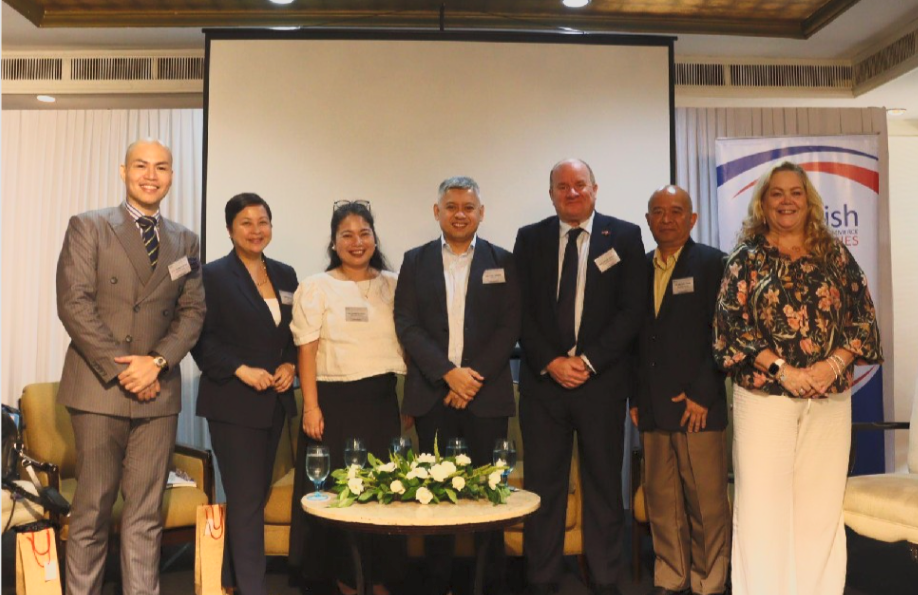
(From Left: Quisumbing Torres Atty. Charles Veloso, HSBC Head of Markets and Securities Services Corrie Purisima, Hon. Usec. Domini SD. Velasquez – Undersecretary and Chief Economist, Department of Finance, Lee Carlo Abadia – Principal, Technology Consulting, SGV & Co., Mr. Mike Welch – Deputy Head of Mission, British Embassy Manila, DICT Dir. Antonio Padre, BCCP Chairman Sarah McLeod)
BCCP Vice Chairman Chris Nelson has always emphasized the urgent need for cybersecurity legislation, calling it “a key issue across economies in the world.” He urged lawmakers to prioritize a comprehensive cybersecurity bill in the next Congress, noting that more than 80% of businesses faced cyberattacks last year. The British Chamber is advocating for three critical laws to support digital transformation: the E-Governance Act, Cybersecurity Act, and Konektadong Pinoy Act. These would establish the regulatory framework for secure, efficient digital government services.
The UK is one of the leading countries around the globe with key expertise in cybersecurity. Currently, British companies such as CyberQ Group and NCC Group are in the Philippines and continue to assist the public and private sectors in ensuring a secure cyber infrastructure. Nelson further explained, “Cybersecurity is a key issue and it is not just impacting the Philippines… We strongly urge the passage of those key legislations which will reinforce, and I think make companies and the public even more aware of this key issue… The Philippines needs to keep up with further developments on things like AI and so forth. If that can be done, then I believe strongly that the Philippines will be seen as a great opportunity for companies to use that talented workforce and keep going forward.”
In support of this view, the Department of Information and Communications Technology (DICT) Director Antonio Padre also identified the need to further strengthen the country’s connectivity and establish a competitive workforce, not limited to the gig economy and the BPO sector, as technology continues to evolve and the Philippines moves towards its digital transformation agenda to further drive its economic growth.