
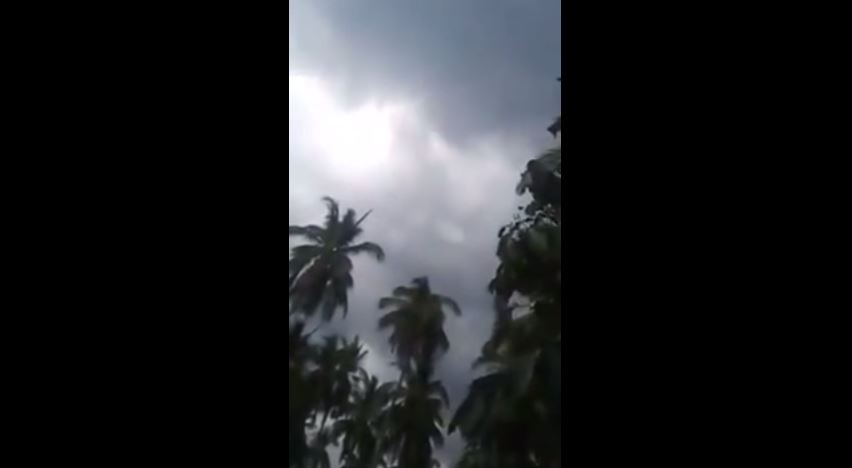
You usually hear trumpets in concerts or bands, but now, you can hear them from the sky.
A video is going viral on Facebook where strange trumpet sounds could be heard from the sky in Batangas. According to TeeFM, who first posted it on Facebook, the sound was heard on June 4 at 3PM.
Netizens posted different reactions.
Some said it is a sign of the Apocalypse, according to the Bible’s Book of Revelations. One local from Batangas said that the sound comes from the nearby powerplant.
Strangely, this sound was also heard in Canada, Australia, Germany, and the US.
In Germany, a video was recorded where a child was scared stiff while the sound was heard. In Canada, a woman heard the sound twice. The second time, her seven year old son was also scared. A man from Montana suffered nightmares after hearing it, waking up screaming in the middle of the night.
But the National Aeronautics and Space Administration (NASA) believe that it is “background noise” from the Earth.
According to them, it happens all the time.
Watch the video taken in Batangas below:
These videos were taken in Germany and Canada:
What do you think? Share your thoughts below!







Explanation from NASA… https://science.nasa.gov/science-news/science-at-nasa/2001/ast19jan_1/
Earth Songs
Our planet is a natural source of radio waves at audio frequencies. An online receiver at the Marshall Space Flight Center is playing these songs of Earth so anyone can listen.
If humans had radio antennas instead of ears, we would hear a remarkable symphony of strange noises coming from our own planet. Scientists call them “tweeks,” “whistlers” and “sferics.” They sound like background music from a flamboyant science fiction film, but this is not science fiction. Earth’s natural radio emissions are real and, although we’re mostly unaware of them, they are around us all the time.
“Everyone’s terrestrial environment almost literally sings with radio waves at audio frequencies,” says Dennis Gallagher, a space physicist at the Marshall Space Flight Center (MSFC). “Our ears can’t detect radio waves directly, but we can convert them to sound waves with the aid of a very low frequency (VLF) radio receiver.”
VLF receivers are simple, yet uncommon. Consisting only of an antenna and an audio amplifier, they are sensitive to radio waves with frequencies between a few hundred Hertz and 10 kHz . For comparison, AM broadcast band radios –like the ones in most automobiles– span the much higher frequency range 540 kHz to 1.6 MHz.
If you have an internet connection you can now listen to a VLF radio anytime you wish. Gallagher and colleagues recently installed an INSPIRE VLF receiver at the MSFC Atmospheric Research Facility in Huntsville, AL. It’s broadcasting the peculiar songs of Earth live on the web 24 hours a day.
The source of most VLF emissions on Earth is lightning. Lightning strokes emit a broadband pulse of radio waves, just as they unleash a visible flash of light. VLF signals from nearby lightning, heard through the loudspeaker of a radio, sound like bacon frying on a griddle or the crackling of a hot campfire. Space scientists call these sounds “sferics,” short for atmospherics.
Even if there is no lighting in your area, you can still hear VLF crackles from storms thousands of kilometers away. Some sferics travel all the way around the Earth! Radio waves can propagate such great distances by bouncing back and forth between our planet’s surface and the ionosphere — a layer of the atmosphere ionized by solar ultraviolet radiation. The ionosphere, which begins about 90 km above the ground and extends to thousands of kilometers in altitude, makes a good over-the-horizon reflector of low frequency radio waves.
“The ionosphere and the surface of the Earth form a natural waveguide for VLF signals,” explains Bill Taylor, a space scientist at the Goddard Space Flight Center. Sferics that travel very far through the waveguide become “tweeks,” which produce a musical ricochet sound in the loudspeaker of a VLF receiver.
Tweeks sound as they do because “their high frequency components reach the receiver before their low frequencies do. We call this delay dispersion, and it’s a result of propagation through a waveguide,” says Taylor. Every waveguide has a low-frequency cutoff set by its physical size. The closer a wave is to the cutoff, the slower it travels. The cutoff frequency of Earth’s planet-sized natural waveguide is around 3 kHz — that’s the frequency where half a wavelength will fit between our planet’s surface and the bottom of the ionosphere. Waves with frequencies above the cutoff can travel through the waveguide, but lower frequency waves cannot.
Sometimes the ionosphere leaks lightning pulses into space. They exit the atmosphere entirely, following magnetic field lines that guide them 10,000 km or more above Earth’s surface, into our planet’s magnetosphere and then back again.
“Lightning pulses that travel all the way to the magnetosphere and back are highly dispersed, much more so than tweeks,” continued Gallagher. “We call them ‘whistlers’ because they sound like slowly descending tones. Whistlers are dispersed, not because of the waveguide cutoff effect, but rather because they travel great distances through magnetized plasmas (a plasma is an ionized gas), which are strongly dispersive media for VLF signals.”
Lightning is striking somewhere on Earth nearly all the time (about 100 times per second), so strange-sounding VLF signals are constantly propagating around our planet. “The best time to listen is usually around sunset or dawn,” says Gallagher. “That’s when electron density gradients that act as natural waveguides form in the local ionosphere.”
Dawn breaks over Huntsville, AL, where the online receiver is located, around 6 o’clock Central Standard time, which is 1200 Universal Time. Sunset is ten hours later at this time of year. “Nighttime is generally better than the day when you’re listening to a VLF receiver,” continued Gallagher, “so anytime between about 2200 UT and 1200 UT is a good time to listen to the online audio.”
Gallagher built the online receiver from an INSPIRE VLF radio kit. INSPIRE, which stands for “Interactive NASA Space Physics Ionosphere Radio Experiments,” is an educational program based at NASA’s Goddard Space Flight Center led by Bill Pine, a high school science teacher in Ontario, CA, and Bill Taylor.
Participants build their own VLF radios and they can join a global network of monitoring stations that includes more than 1500 schools. “Almost anyone who can learn to solder can build one of these receivers,” says Gallagher.
Taylor, Pine and others frequently organize experiments for members of the network. For example, in 1994, listeners across North America monitored terrestrial VLF radio waves during a solar eclipse. The observations revealed how a temporary decline in solar ultraviolet radiation affected Earth’s ionosphere. In 1999 and 2000, an INSPIRE receiver floated to the stratosphere on a weather balloon to listen for plasma wave emissions from Leonid meteors. Students monitored the meteor shower from ground stations at the same time.
To hear sample VLF radio sounds, or to listen to the online receiver itself, point your web browser at SpaceWeather.com’s online INSPIRE page. If listening to our online receiver whets your appetite for one of your own, visit Goddard’s INSPIRE web site for information about ordering a receiver and joining their program.
Is this is one of HIS signs?
“Then will appear the sign of the Son of Man in heaven. And then all the peoples of the earth will mourn when they see the Son of Man coming on the clouds of heaven, with power and great glory.”
“And he will send his angels with a loud trumpet call, and they will gather his elect from the four winds, from one end of the heavens to the other.”
(Matthew 24:30-31)
HOAX!! Hahaha.
Already debunked by this video. 🙂
Go to 2:34 of the video below. And 0:24 of the Batangas video above. Same “bird call”. Same sound clip was used. Very amateurish. They are just attention-seekers. Haha.
https://www.youtube.com/watch?v=YVScTxRBHFY
https://www.sott.net/article/240863-Strange-Sounds-in-Sky-Explained-by-Scientists
This is much better.
sir ang may maisulat lang just to view your blogs tsk.