When in Manila, every citizen knows that traffic in the Philippines is inescapable. The only time you can drive freely with minimal headaches is during wee hours. Truthfully, a lot of government officials have shared their resolutions about the unacceptable situation. One of which is the Metropolitan Manila Development Authority or MMDA. It has established and implemented solutions that could somehow help decongest the traffic problems in the country. One of the many regulations MMDA had presented was the Number Coding.
What is Number Coding?
According to the MMDA website, the Number Coding, formerly known as, Unified Vehicular Volume Reduction Program, is a traffic decongestion scheme which bans private and public utility vehicles using the main roads during peak hours. The scheme was first implemented in 1995.
Generally, the scheme prohibits cars from using the main roads, especially, if your plate number ends in the following category:
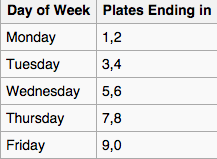 Source: MMDA.gov.ph
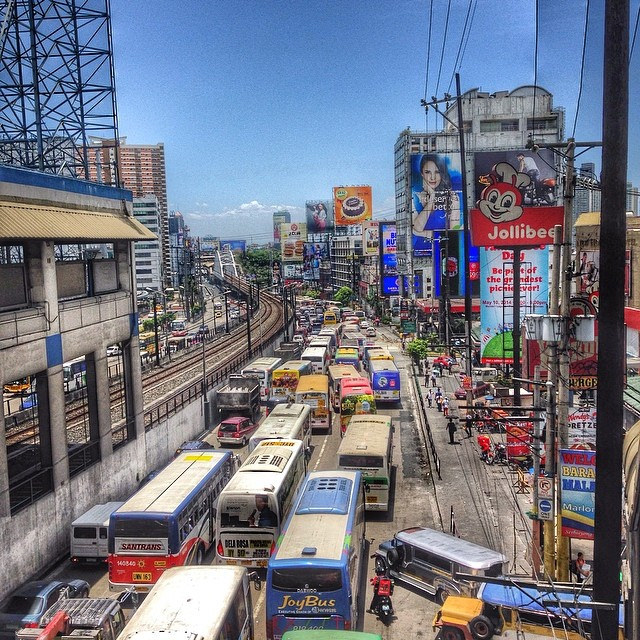
Unfortunately, even with the number coding scheme, the traffic in the Philippines is still horrible.
Admittedly, despite spreading awareness about the said scheme, others still find number coding confusing. Because there are municipalities that allow cars even if they are “coding.” Moreover, there are rules and regulations MMDA implemented that others aren’t aware of. For example, “swerving.”
What is “Swerving?”
As explained by the MMDA website, swerving is a movement wherein vehicles shift from a lane to another. However, it could be tagged as reckless driving if done abruptly and irresponsibly. (E.g. swerving in an abrupt and careless manner, swerving without the use of signals, swerving across solid lines).
So, to enlighten everyone, a netizen by the name of Paul Libid, shared an informative post in Facebook, which I think will help EVERY ‘JUAN.’
I suggest to read, screenshot, and have the post below information printed out:
1.Swerving, defined as vehicle movement from a lane to another, is not a traffic violation per se, but it can constitute the offense of ‘Reckless Driving’ if it is done without precautions (e.g. swerving in an abrupt and careless manner, swerving without the use of signals, swerving across solid lines). It can also constitute the offense of ‘Disregarding Traffic Signs’ for areas where signs are present explicitly prohibiting swerving. Mentioning the names of any of the MMDA officials when apprehended will not afford anyone any special treatment.
Kotong cops love to arrest people for swerving. What you can do:
Confidently and politely assert your knowledge of the rules and your rights.
Ask for a ticket and the name of the arresting officer. The ticket will identify the policemen and serve as evidence if you complain against them at the MMDA for extortion.Drop the name of Corazon Jimenez, MMDA General Manager, who is in charge of these MMDA cops. (She is a graduate and former professor of AIM; personally recruited by MMDA Chairman Tolentino also of AIM.)
2.
As a general rule, driver’s licenses are not confiscated but only borrowed for purpose of identification, except on the following situations: – The driver was involved in a traffic accident – The driver has accumulated three (3) or more unsettled violations – The driver has been apprehended for the following administrative violations:
• Allowing another person to use driver’s license
• Broken sealing wire
• Broken taximeter seal
• Colorum operation (cargo/passenger vehicle)
• Driving against traffic
• Fake driver’s license
• Fake/altered taximeter seal
• Fake/altered sealing wire
• Fast/defective/non-operational/tampered taxi meter
• Flagged up meter
• Illegal or unauthorized counter-flow
• Illegal transfer of plates/tags/stickers
• Joined/reconnected sealing wire
• No driver’s ID
• Ignoring Organized Bus Route (OBR) interval timers (for 2nd offense)
• Skipping or bypassing designated OBR terminals or loading bays (for 2nd offense)
• Operating on contractual basis
• Out of line operation
• Overcharging (with or without conductor) (for the 2nd offense)
• Over-speeding
• Refusal to convey passengers to destination/trip-cutting (Taxis and Public Utility Vehicles)
• Refusal to render service to public (Taxis and Public Utility Vehicles)
• Tampered sealing wire
• Tampered taximeter seal
• Tampering of OR/CR/CPC & other documents (spurious documents)
• Undue preference/unjust discrimination
• Using motor vehicle in commission of crimeThe above-mentioned administrative violations also require a minimum of 2 hours seminar (for the drivers) at the Traffic Academy. However, any driver who has committed three (3) or more unpaid violations, whether administrative or moving, shall also be subject to attending seminars, whose length shall be based on the results of the diagnostic exam (exam that will determine the contents of the seminar progress), which will be administered by the Agency. If the license is to be confiscated, the Traffic Enforcer should inform the driver of the reason/s for the confiscation and the ticket validity. If the driver refuses to surrender his driver’s license, his plate may be detached pursuant to Section 74 & 75, MC 89-105.
3.Vehicles with senior citizens on board are not exempted from MMDA traffic rules like Number Coding.
MMDA personnel on the road are allowed to work in groups for special operations, including but not limited to smoke belching operations, anti-drunk driving, anti-over speeding operations, anti-colorum/out of line operations, etc.
5. Right-turning private vehicles are allowed in the yellow lanes, provided that they start shifting lanes upon seeing the transition lane (broken white lines painted diagonally), that you can see around 50 meters away from an intersection. PUBs which go out of the yellow lane will be apprehended for violating the yellow lane policy, except provincial buses, point to point buses and express connect buses.
6. All reports and complaints regarding MMDA road operations should be directed to the MMDA’s Public Concerns & Responses Management Unit, MMDA official hotline (136), or through the MMDA official Facebook and Twitter accounts.





Yup, please update. Parañaque has adopted the number coding scheme. Also, this should read PASAY City, not “Pasig City: Window hrs 9 am — 4 pm
Number Coding except on: Ninoy Aquino Avenue, MIA Road, Domestic Road, portions of Airport Road, Sales Road, Tramo.”
instead of putting a lot of effort coming up with ‘schemes’, why can’t people with authority come up with something practical…oh i don’t know, maybe getting rid of those damn jeepneys and private buses??? those jeepneys are way past their time, they’re an eyesore and a nuisance. instead of private buses, why not have local governments manage public transportation systems, complete with buses and shuttles that run regularly and efficiently, like what you find in developed countries? not doable in the philippines? why? because our government officials are bobos and bobas, who are natural thieves and swindlers? ok well never mind. enjoy your daily traffic enema.
[Admin 06] Hello, everyone. Some of the information in this article are inaccurate and not updated. Kindly refer to our post about this at https://www.facebook.com/MMDAPH/posts/1046888458683149. Thank you.
This number coding scheme only forces capable Filipino families to buy another car or two (or three, mayayabang eh) and in turn, other members of their family would have that luxury to occupy more space on the road. Due to the Filipinos’ rising purchasing power, virtually everyone can buy a car in the Philippines, which makes everything worse.. Not to mention the ease of getting license by simply paying fixers in LTO. Tuloy, nagkalat ang mga presko, barumbado and mga kaskasero sa daan.
Aside from these corrupt MMDA officials who prey on motorists’ ignorance of the law, our public transport are spearheaded by some of the most undisciplined and discourteous drivers in the world (e.g. jeepney drivers who stop in the middle of the road, swerving bus drivers in EDSA, mga tricycle na pasingitsingit) which these MMDA officials often don’t reprimand because they can’t extort money from them. There’s just simply no proper regulation in establishing transport operating businesses in this capitalist country. (Go to EDSA and you’ll see the number of growing independent bus terminals) To address this, public transport must and should be monopolized by the government. And please don’t mention about commuters and pedestrians who just seem to not care if they’re causing delay on the road. (sasakay talaga sa gitna ng daan?)
Another thing I can’t understand is why we have flimsy public infrastractures. Yes we do have enough roads in the country but the quality is just always subpar. I mean look around you. Sadly, the ridiculous taxes we pay goes to the pockets of DPWH officials and these greedy contractors. There has always been rampant overpricing on gov’t projects and it just seems like pointless and questionable road construction and repair would never end. If only people in this sector did their jobs well, more citizens (of all classes) would have been more encouraged to use public transport which will surely lessen the average daily traffic volume, keyword: would have.
This traffic were experiencing now is not a sign of economic progress like what our incompetent president said, (apparently may “wang wang” padin at marami paring pa-VIP) but a testament of lack of good governance and our collective unruliness on the road. See what too much freedom can do? Anyway, who fought for this shitty 1986 constitution which allows these abominable conditions to occur in the first place?
Except your photo is that of Bangkok and not Manila. And that you failed to credit https://environment.nationalgeographic.com/wallpaper/environment/photos/urban-threats/bangkok-traffic/