This November, the contemporary pioneer of PiñaWear presents a collection of piña “shirt stories” that explore the harmonic possibilities of the handwoven pineapple fabric.

Photo: TAN-GAN
Artisanal fashion designer Lulu Tan-Gan is often called the Queen of Knits. But in the last two decades, she has dedicated herself to presenting the traditional piña fabric through a contemporary, global lens. By specializing in piña fashion, Tan-Gan has paved new paths to develop, innovate, and ultimately cultivate a modern, luxury market for piña.
Tailored traditions: Tan-Gan’s shirt stories
“Ultimately, my work is about bridging tradition and innovation, honoring our heritage while giving it a fresh expression for today,” said Tan-Gan. This November, the designer will unveil a pop-up space at the Powerplant Mall, where she will launch Tailored Traditions.
“With the rising interest in Piña, I feel that I have come full circle,” she said. “Over the past 20 years, I have explored and tested this raw, ethereal fiber through various forms of fabric manipulation. With Tailored Traditions, I return to the essence of my journey: modeling heritage for contemporary use.”
The collection brings together two enduring classics: piña fabrics and tailored shirts. Barongs, oversized dress shirts, and vests are impeccably crafted from the finest piña fabrics and blends, echoing Tan-Gan’s design DNA.
“This is artisanal fashion that embodies understated luxury, with travel-friendly designs that seamlessly blend practicality, elegance, and the timeless beauty of piña. It brings together heritage and vintage influences with a sporty chic sensibility.”
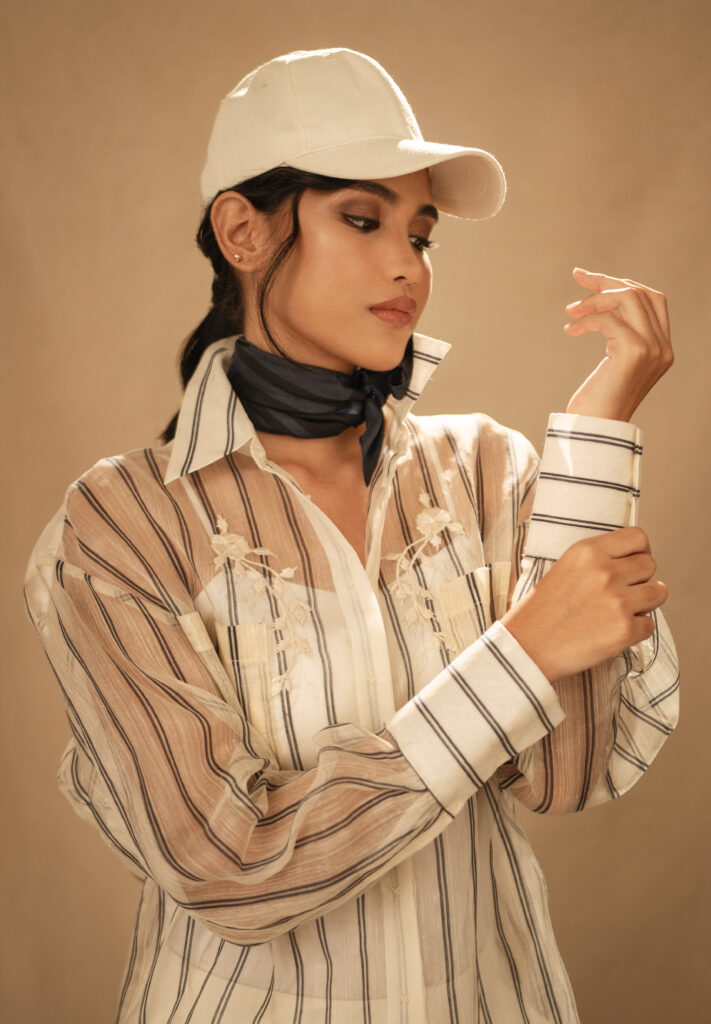
Photo: TAN-GAN
Shirts from the collection will also mirror Tan-Gan’s 20-year journey with piña. Through sustained experimentation and refinement, the artisanal designer explored new ways of working with the heritage textile, moving beyond its traditional associations. Her approach re-imagines piña as fluid, wearable, and relevant to contemporary lifestyles.
This exploration has yielded a range of design possibilities through textile manipulation, surface treatments, and new colorways that lend the material its contemporary allure while preserving its inherent character.
Tan-Gan intentionally returned to the basics with her Tailored Traditions. The designer, purveyor, and cultural advocate said: “In a world often obsessed with extravagance, true luxury resonates with those who understand the value of refinement and quiet confidence. It transcends trends and ostentation, focusing instead on the inherent beauty of materials and craftsmanship. It embraces simplicity and authenticity.”
At the forefront of artisanal, zero-waste fashion
Instead of designing around fabrics or materials readily available, Tan-Gan prioritizes mastery of craft.
“As an artisan, you have to understand the material and the technical side of constructing before you can innovate and make it relevant to use,” she stated. “Crafting fashion has always been central to my work. “Yarn is my medium. Knitting and weaving are my languages. My process begins with inspiration from our indigenous traditions, craft, and nature.”
In the late ’70s and early ’80s, Tan-Gan began creating hand-loomed knitwear outside of the usual cardigans and sweaters. By 1983, her handcrafted knits were shown on the runways of Paris Fashion Week.
“Drawn to the ease of wash-and-wear fabrics that didn’t need ironing,” she recalled, “I wanted to transform knitwear into fashionable pieces for career women like myself who needed practical and stylish options.”
Decades before terms like sustainability and small batch were buzzwords in the fashion space, Tan-Gan was already knitting garments to shape using a hand loom. This unique process and technique placed the designer at the forefront of artisanal, zero-waste fashion early on.
From knitwear to PiñaWear: keeping tradition alive
After 20 years of working with knits, Tan-Gan introduced PiñaWear, primarily conceived as a ready-to-wear line.
It transferred the designer’s expertise, design philosophy, and creative process from knits to piña. Her personal introspection sparked the shift.
“What makes me a Filipino designer?” she pondered. “I was always attracted to piña and loved the ethereal beauty of the fabric. I would wear my dad’s barong and adored the pieces made by Barge Ramos using the handwoven fabric.”
It also dawned on the artisanal designer that preserving the time-honored fabric—and keeping it relevant—demanded innovation through design and product development.
“Tradition thrives when it evolves through contemporary participation. Adding that fashion-forward factor keeps tradition alive, relevant, and continuously inspiring,” Tan-Gan observed.

Photo: TAN-GAN
Reframing perceptions, rewriting the rules
She began by reframing the market’s perception of piña. Back then, the material was seen as a stiff fabric, used only for formal wear. It also required dry cleaning, making it costly to maintain. Tan-Gan saw potential in reintroducing handwoven pineapple fabric as a versatile material, ideal for ready-to-wear garments and modern classics such as shirt jackets, boleros, capes, coats, and caftans.
The artisanal designer shared, “I started to develop piña into washable, fluid textiles. I designed and engineered it for easier packing and travel.”
She rewrote the conventional rules of engaging with and working with the textile by dissecting its warp and weft. Tan-Gan learned to cut the fabrics with clinical precision such that they draped or fell from the body more fluidly.
“I mostly engage with piña through the cutting process. I love the crisp sound while cutting,” she said. “As I lay out the pattern, my design often evolves. I may lengthen, widen, or reshape it. I’m also mindful of ensuring that no inch of the weave is wasted throughout the design and cutting process.”
Like any true artisanal designer, Tan-Gan has also immersed herself in dyeing, washing, and creating her own local motifs. She detailed, “I use piña and mix blended fabrics, dye, prints, and beading to create different textures and patterns. This allows the textile itself to guide the design. Once the fabric comes to life, I explore how it can be transformed through draping, pleating, and other new techniques.”
Tan-Gan’s pieces were deliberately unlined, allowing the fabric’s ethereal beauty to shine through. She also proposed a more contemporary way of fashioning the textile by layering it over innerwear like skin-friendly shirts, chemises, or lace.
Returning to source
Tan-Gan’s work with piña began when Western design sensibilities dominated the local fashion scene.
Tan-Gan remembers, “Piña was still largely unfamiliar, and its potential beyond traditional use was not yet widely understood.”
Today, discerning luxury fashion consumers strongly prefer artisanal pieces that honor tradition, craft, source, and identity.
“It’s not simply about individual garments,” the artisanal designer emphasized. For her, the most important fashion conversations begin with the source and are shaped by mastery of craft. “When I talk about ‘farm-to-fashion,’ I am referring to how we source our fabrics—understanding that our textiles come from the provinces and the farms where our weaving traditions continue to live on. This awareness helps us to develop a more sustainable, circular fashion industry in the future.”
Through continuous experimentation, exploration, and engagement, Tan-Gan has tracked a creative journey where time-honored tradition and design innovation meet at the crossroads.
She reflects on her life’s work both then and now, concluding: “It’s about transforming craft, textile heritage, and traditional techniques into global contemporary fashion. It means transforming our traditional textile into a symbol of elegance, innovation, and timeless sophistication—crafted for the modern fashion connoisseur who values both heritage and cutting-edge design.”
TAN GAN’s Tailored Traditions will launch this November at the designer’s pop-up space at the 2/F Powerplant Mall. For more information, follow TAN GAN on Instagram @tan_gan.
Do you have a story for the WhenInManila.com Team? Email us at wheninmanila@gmail.com or send us a direct message at WhenInManila.com’s Facebook Page. Interact with the team and join the WhenInManila.com community at WIM Squad, and join our Viber group to stay updated with the latest around the Philippines and beyond!